Have you also been called from an unknown foreign number? (one-ring scam)
Since 2018, Hungarians have been getting calls from unknown foreign phone numbers – a well-known scam. We plucked up the courage to call back one of the – American – numbers, and within half a minute it became clear how sophisticated the unknown fraudsters' method is. But we don't recommend this to anyone, because calling back is exactly how the scammers take money from unsuspecting victims.
The call immediately became suspicious when a pleasant female voice purred that „my phone number had been randomly drawn". Sure – in the United States, a Hungarian number. I didn't listen to how big the prize was or the conditions for claiming it, because the whole thing screamed huge scam.
Asked by us, Hungarian providers confirmed they had come across such calls in recent days. Their customers also sent feedback, and the increased call traffic was visible in their systems.

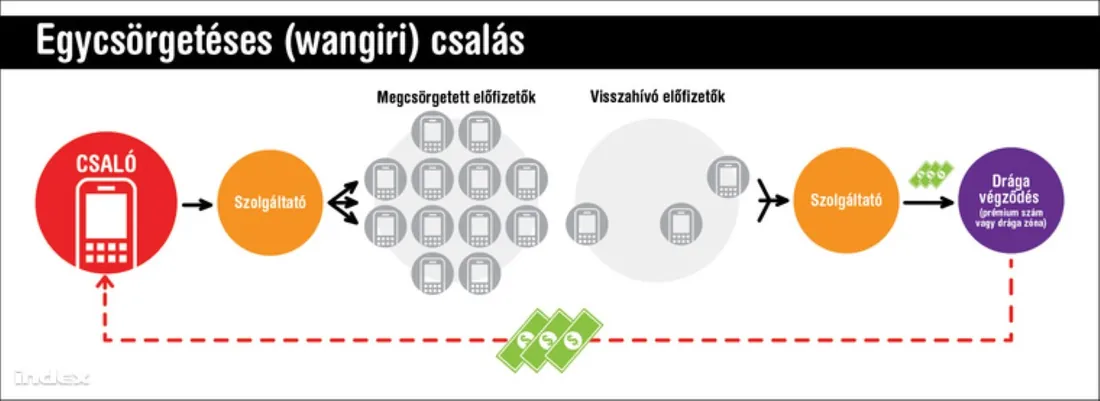
Receiving a call on the domestic network is free, but the attackers don't want us talking at their expense anyway, so as soon as we answer they hang up (this type of scam even has a Japanese name, wangiri, meaning: ring once, then hang up).
Here's what the value chain looks like:
- Today anyone can buy a phone number online with a few clicks, for next to nothing – that's what the scammer did.
- Using a computer, from a list or completely at random, he rings a huge number of phone numbers, so that people call back.
- If someone calls the number back, an international line is set up. That costs money even if it's not a premium-rate number. Since international billing is per minute, calling back such a number even for a second means paying for a whole minute. Under their basic agreement, the (GSM) providers settle accounts with each other based on the traffic measured on both sides. If it matches, they pay.
For example:
- A subscriber in Hungary calls Chad, which is in zone 6; a call there can cost around 500 forints on average – because forwarding it costs everyone money. The Hungarian provider pays this money to the first international carrier forwarding the call.
- There's no direct connection between Hungary and Chad, no cable linking exactly them, so the call first goes out to a neighbouring country, where forwards it for a fee (around 50 forints on average, passing on the rest) a provider in, say, Austria to the international hub in Germany;
- which also forwards it for a fee (another 50 forints, paid by the previous provider) one step closer to Chad;
- There can be quite a few providers in this chain, each taking its cut;
- Then we reach the owner of the number range (+235 XXXXX), who keeps another 180 forints (the exact amount is a matter of contract) for forwarding the call to the owner of the number bought online.
- The scammer bought the number from the range owner on terms that give him a share of what remains from incoming international calls.
Magyar Telekom wrote to us that, unfortunately, many people call the number back without checking what number the incoming call came from or who the caller was. The provider tries to minimise the risks of various types of abuse, but scams are constantly evolving too, appearing in ever newer variations. They advise customers always to act consciously and carefully to avoid abuse.
Telenor also took preventive steps against the scammers. They said they too had received feedback from customers, but had already spotted the increased call volume and restricted the ability to call these numbers back.
Our systems continuously monitor and automatically flag when an international number has an unusually high number of calls, and we take steps to prevent our customers from calling them back.
– wrote Telenor.
Vodafone's press office said the phenomenon, affecting customers of all three providers, is a well-known abuse method. Over the weekend, scammers tried to get mobile customers to call back international premium-rate numbers. Vodafone has blocked, and keeps blocking, calls back to the numbers concerned from its network.