
China unveils its new invention: the mosquito drone that secretly films and eavesdrops
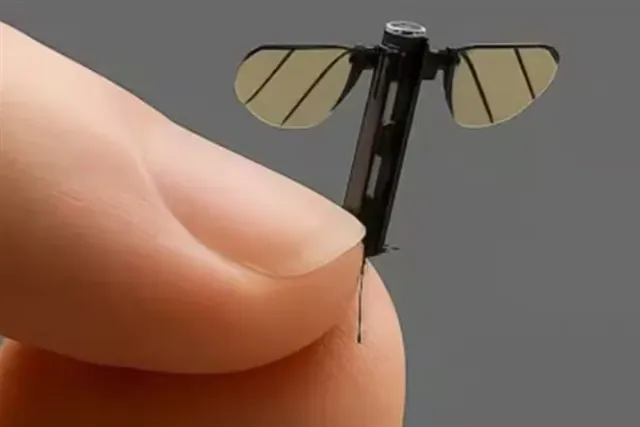
They showed what a robot disguised as a mosquito can do
On 20 June, China unveiled one of its strangest developments: a drone just 2 centimetres long that looks deceptively like a mosquito. The unusual robot was presented by China's state military channel CCTV-7, and the footage clearly shows Liang Hexiang, a student at China's National University of Defense Technology holding the tiny device in his palm.
„I have a mosquito-type robot in my hand. Miniature bionic robots like this are ideal for special missions and reconnaissance on the battlefield," Liang said on television.
The drone weighs barely 0.3 grams, can beat its wings 500 times a second, has three thin legs, and hides various surveillance sensors inside. According to experts, its size makes it almost impossible to detect by radar.
The „mosquito drone" isn't just extremely small but also technologically advanced: it can stream live images and be controlled from a phone. The Chinese team also showed another version with four wings, likewise controlled from a mobile device. Although they didn't officially say what kind of data it can collect, it's presumably designed for covert surveillance, possibly even in active war zones.
The invention raises serious questions about the ethics and security of modern spyware and surveillance systems, especially in an era when technology is becoming almost completely „invisible".
But China isn't alone in this: the United States, Norway and South Korea are also working on similar micro-drone technologies. Norway, for example, has already created the „Black Hornet", a palm-sized helicopter with a thermal camera that the US Army already uses. And back in 2006, the US research agency DARPA launched a project to fit microchips to real insects, creating living „cyborg insects" for surveillance.
While conventional, larger drones are easier to spot and bring down, these barely noticeable micro-robots are much harder to track. They can get into a room, record video or audio undetected and disappear without a trace.
„This is a huge leap in the world of invisible surveillance. If this technology falls into the wrong hands, it could pose a serious threat to privacy and national security," a military technology expert told the South China Morning Post.