China unveils a new quantum computer prototype in its computing-power race with the United States

In October 2024, Chinese scientists unveiled a new quantum computer prototype based on 255 photons, called „Jiuzhang 3.0". Quantum physicists Pan Jianwei and Lu Chaoyang, who lead the research team, say their algorithm could cement China's world-leading position in quantum computing research and development.
According to the team of scientists from the University of Science and Technology of China and the Shanghai Institute of Microsystem and Information Technology, part of the Chinese Academy of Sciences and the National Parallel Computer Engineering Technology Research Center, Jiuzhang 3.0 can solve extremely complex Gaussian boson sampling (GBS) problems up to 10 quadrillion times faster than the world's fastest supercomputer.

Gaussian boson sampling is a test in which supercomputers are given a quantum sampling task to demonstrate their computing speed in solving well-defined problems extremely efficiently.
Quantum computing, a concept first proposed by Nobel laureate Richard Feynman in 1981, is a revolutionary way of computing that solves mathematical problems by organising quantum bits according to the principles of quantum physics.
This type of computing was designed specifically for complex calculations such as cryptography, big data optimisation, weather forecasting, materials design and drug analysis, while conventional computers are used for simpler calculations.
China's „Jiuzhang 3.0" is 10 quadrillion times faster than the world's fastest supercomputer
According to a press release Pan and Lu's research team sent to the Chinese newspaper Global Times, Jiuzhang 3.0 set a world record in optical quantum information technology by solving GBS problems 10 quadrillion times faster than supercomputers.
Jiuzhang, which made China only the second country to achieve quantum supremacy, is named after the ancient Chinese mathematical work known as „The Nine Chapters on the Mathematical Art".
A study published in the online journal Physical Review Letters suggests Jiuzhang 3.0 processes Gaussian boson sampling a million times faster than its predecessor Jiuzhang 2.0, which can use 133 detected photons.
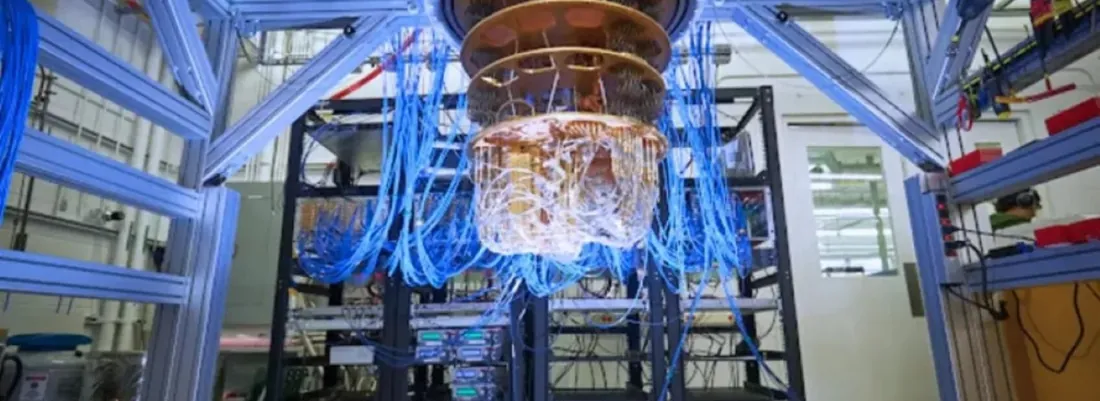
Jiuzhang 2.0 could calculate the most complex GBS problems in 1 microsecond. Meanwhile Frontier, currently the world's fastest supercomputer, would take over 20 billion years to solve the same equations.
Speaking to the Global Times, Professor Lu Chaoyang stressed that the Jiuzhang 3.0 prototype is currently used for graph theory problems, but the algorithm will also be deployable in materials design in the future.
The professor at the University of Science and Technology of China said his team made a number of innovations during the research, such as superconducting nanowire single-photon detection with a fibre-loop configuration, which raised the number of detected photons from 133 in Jiuzhang 2.0 to 255 in Jiuzhang 3.0. He says the technology has greatly improved photonic complexity in quantum computing.
China aims to boost its computing power by 50% by 2025
On Monday, the Ministry of Industry and Information Technology (MIIT) published its goal for the country's total computing power to reach 300 EFLOPS by 2025, a 50% increase on current capacity.
EFLOPS is a unit used to measure computer speed, where one EFLOP equals a quintillion floating-point operations per second.
In August, the MIIT revealed that China's computing power reached 197 EFLOPS in 2023, up from 180 EFLOPS the year before. Despite major leaps, China still lags behind the United States in total computing power. In 2022 the US reached an estimated 200 EFLOPS, and it keeps growing this year.
Under the plan, Beijing intends to build more data centres nationwide to make it easier for businesses to access computing power. The government also plans to extend China's computing infrastructure to the country's vast but sparsely populated western provinces, building huge data centres there to serve the internet.
Apple is among the tech companies that have already set up data centres in the region to serve their Chinese customers.